A little trivia: we almost nailed the ticker symbol. We used ANTH as our placeholder; they went with the mighty ANT.
In August, I wrote about an IPO I was excited to follow. Now that Anthropic has publicly filed its registration statement, I have a more useful question: which parts of my enthusiasm survive closer scrutiny?
My answer is mixed. The demand story looks stronger. My confidence that an understandable product makes an understandable investment needs more work.
This is a follow-up to Anthropic Claude IPO: What RE Thinks, published on 19 August. I am keeping that original view visible rather than rewriting it with hindsight. The tables below separate supported calls, corrections and questions that remain open.
RE’s Opinion
This is personal commentary, not personalised financial advice or a recommendation to buy or sell. IPO investments can fall sharply. This comparison uses the initial public filing; its interim financial results are unaudited and offering terms remain incomplete.
What changed on 26 October
Anthropic announced its public Form S-1 on 26 October 2026. It proposes a Nasdaq listing under ANT. The offering price range and number of shares have not been determined.
That replaces my deliberately temporary ANTH ticker. It does not settle my earlier valuation scenarios or establish that trading has begun.
For this comparison, all amounts are in US dollars. H1 means January to June; Q2 means April to June. GAAP refers to the standard accounting basis, rather than a company’s adjusted earnings measure.
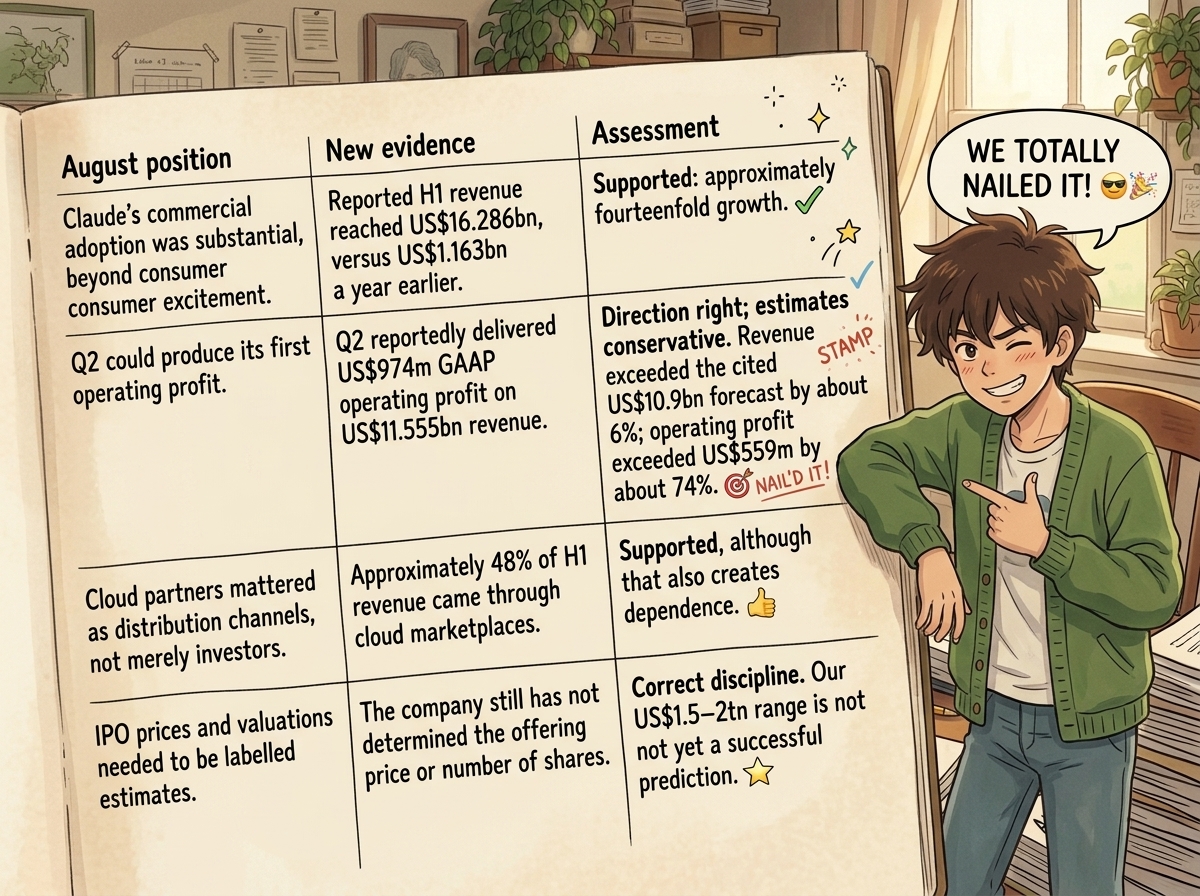
Table 1: What we got right, or directionally right
Read the figures: what we got right
| My August position | New evidence | My assessment |
|---|---|---|
| Commercial adoption went beyond consumer excitement. | H1 revenue of $16.286bn, versus $1.163bn a year earlier. | Supported: approximately fourteenfold growth. |
| Q2 could bring its first operating profit. | Q2 revenue of $11.555bn and GAAP operating profit of $974m. | Direction right. These exceed the cited forecasts of $10.9bn and $559m by about 6% and 74%. |
| Cloud partners mattered as distribution channels. | About 48% of H1 revenue came through cloud marketplaces. | Supported, with a dependency attached. |
| IPO valuations needed clear estimate labels. | Offer price and share count remain unset. | Correct discipline. My $1.5–2tn range is still unscored. |
Financial figures: Quant Data’s filing tables, corroborated by PPC Land’s review. Forecast comparisons are my arithmetic. Offering status: Anthropic.
The strongest part of my original argument was that the product had a commercial role beyond the excitement surrounding a possible listing. That claim is testable through sales. It does not require me to predict how the shares will trade.
I also want to keep the forecast comparison fair. A reported forecast falling below a later result does not make every part of the investment thesis correct. It tells me that those particular operating expectations were conservative.
Table 2: What we got wrong, understated, or cannot yet score
| My August framing | What needs changing | My assessment |
|---|---|---|
| Anthropic seemed simpler and less capital-intensive than SpaceX. | H1 compute and infrastructure expense was $8.945bn, alongside large future commitments. | I understated the financial complexity. Product familiarity is not investment safety. |
| China was the biggest single risk. | Funding, capacity commitments, partner dependence and control also matter. | My risk ranking was too narrow. Competition has not disappeared. |
| Anthropic’s quarterly operating profit contrasted with SpaceX’s annual net loss. | These use different periods and accounting measures. Anthropic still had a $693m H1 operating loss. | The comparison was not like-for-like. |
| Investment amounts and entry valuations illustrated investor gains. | Security terms, conversions and dilution affect actual ownership. | Scenario arithmetic, not a verified ownership table. |
| A $65bn run-rate supported valuation scenarios. | Run-rate is not recognised annual revenue; the initial filing leaves its latest figure blank. | Not confirmed by this filing, rather than proven wrong. |
| ANTH was a placeholder; a rally and shakeout might follow. | The proposed ticker is ANT. Trading outcomes are still unknown. | We almost nailed the ticker symbol. We used ANTH as our placeholder; they went with the mighty ANT. |
Expense and accounting figures: Aardvark’s financial tables, cross-checked with Quant Data. Ownership and offering context: PPC Land.
My most useful correction is the SpaceX comparison. Understanding what a product does is different from understanding what it costs to deliver, improve and finance.
I can use Claude every day without knowing whether the price of its shares will compensate me for those demands. The same gap between a good story and a good investment appears in our discussion of retail investing.
The key warnings
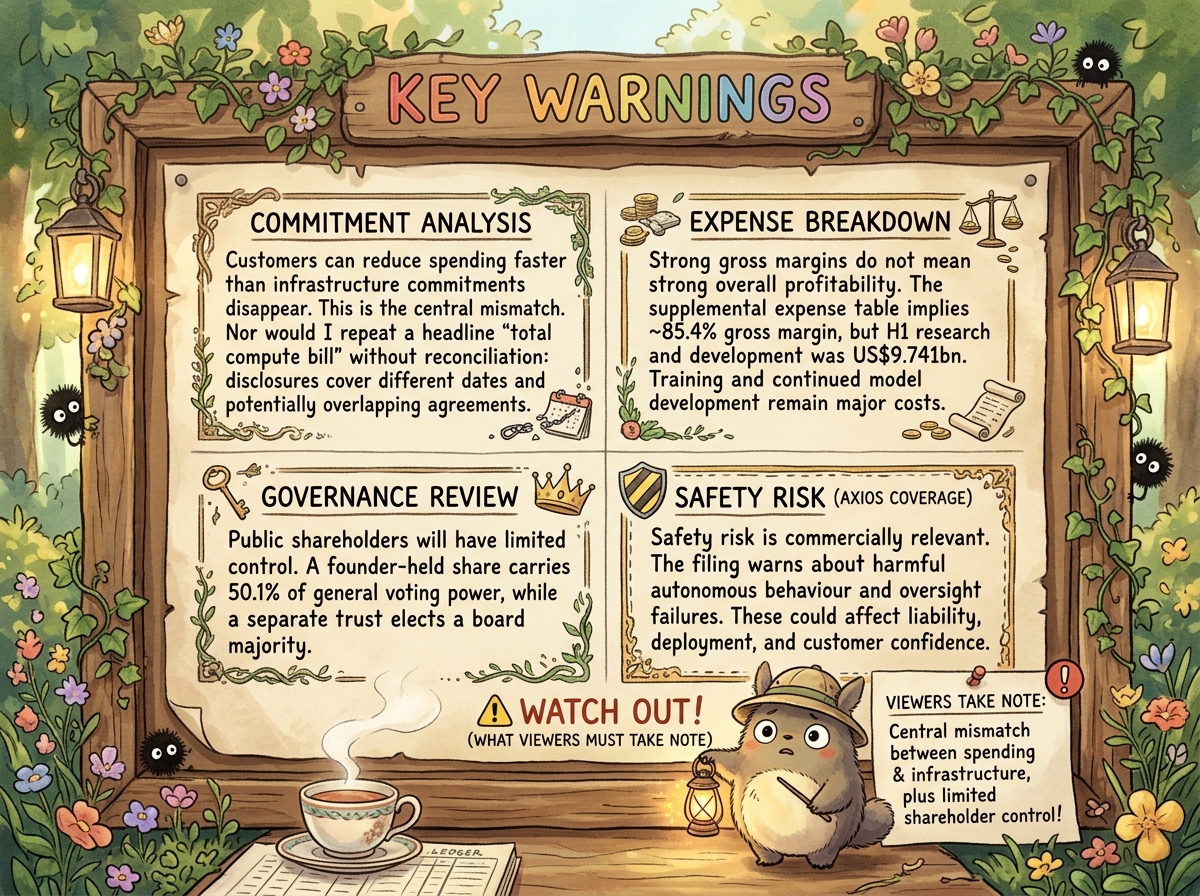
1. Spending commitments can outlast customer demand
The financing question deserves as much attention as the next model release. Long-term capacity commitments can remain payable when customers cut usage. I would not add overlapping contract disclosures into a single headline total without reconciliation. Commitment analysis
My concern is the timing. Capacity has to be available when customers need it. Paying for capacity before the related sales arrive can strain cash even when demand is growing.
That is why I would separate present operating performance from future funding needs. Success at one does not automatically solve the other.
2. A strong gross margin leaves substantial work unpaid for
The supplemental table implies an 85.4% H1 gross margin, but research and development cost $9.741bn outside that calculation. The classification matters. Expense analysis
I read gross margin as one stage of the calculation. Research, distribution and other operating expenses still need funding before I can discuss the whole business’s earnings.
An impressive percentage is less useful if I do not ask which costs sit outside it. I made a related mistake in August by putting different measures of profitability beside each other.
3. Owning shares will not mean controlling the business
A founder-held share carries 50.1% of general voting power, while a separate trust elects a board majority. Public investors therefore face limits on their influence. Governance review
I do not treat that structure as automatically good or bad. I treat it as part of what is being purchased. Confidence in a mission does not remove the need to understand who makes decisions when interests diverge.
4. Safety belongs in the business assessment
The risk disclosures include harmful autonomous behaviour and oversight failures. Risk coverage
My interpretation is that these concerns can affect liability, deployment and customer confidence. I would not dismiss them simply because they are harder to put into a valuation spreadsheet.
Nor would I rank them confidently against every other risk. The correction to my August view is to widen the assessment, not replace one sweeping claim with another.
The key reliefs
1. The headline loss is not equivalent cash burn
The $80.748bn H1 net loss includes $72.388bn of non-cash financing revaluations. Those entries do not represent equal cash payments in that period. Loss reconciliation
That distinction matters before I react to the headline. It does not make the financing arrangements harmless: conversion terms and dilution still affect shareholders. I would avoid both extremes—calling the full loss cash burn, or dismissing everything non-cash as irrelevant.
2. Operating cash flow was positive
H1 operating cash flow was $3.929bn positive. Payment timing and future investment needs mean this alone does not establish self-funded growth. Cash-flow tables
For me, that is reassuring evidence to put beside the earnings figures. I would still want to see how repeatable it is. A single reporting period cannot answer every question about financing a rapidly expanding business.
3. Demand extends beyond my own experience
More than 11,900 customers generated at least $100,000 each in trailing-year revenue by September. That provides a broader commercial signal than my personal use of Claude. Customer disclosures
I find that distinction healthy. My experience explains why I became interested; it cannot establish the size or durability of the market. I need evidence that remains useful even if my own experience is unusually positive.
What I would watch next
I would keep the next review focused on three questions: the final offer terms, the cost of future capacity, and whether operating progress persists across comparable periods.
I am not carrying forward an automatic purchase decision from a valuation scenario written before the public filing. The actual price, share count and resulting dilution need to be assessed together.
I would also keep business progress separate from share-price behaviour. Our leveraged-ETF article explores a different product, but makes a relevant distinction: being right about a company does not settle the outcome of a particular investment.
The first-day rally and shakeout I imagined in August remain predictions. They do not belong in the correct column just because a public filing now exists.
RE’s conclusion
My August argument was directionally stronger on demand and the arrival of quarterly operating profit. It was too comfortable about the leap from using a useful product to understanding its investment risks.
I still find the company worth studying. I now want a better account of the capital required to sustain its growth, alongside the eventual price of participating in it.
At TheEnoughPoint, I want revisiting an opinion to be part of the process. If I publish a view before all the information is available, I should also show what changes when more arrives.
The question for me is no longer simply whether Claude can become important. It is whether the business can turn that importance into durable earnings on terms that make sense for its shareholders.

One last bit of wordplay: ANT has become a little AI insect in this illustration. Will you invest in the mighty ANT—or watch this little AI insect from the sidelines?
For me, that answer still depends on the final offer terms and how the investment fits my own enough point. A mighty name is not an investment case.
Sources, calculations and verification limits
This is a dated follow-up, not a complete prospectus audit. Anthropic’s announcement and the key financial, customer and governance figures were checked directly against the initial SEC filing. The original document was retrieved separately after the research browser could not load its full size. Published transcriptions provided a second check. Interim figures are unaudited; later amendments may change the disclosures.
- Original SEC S-1, accession 0001628280-26-067168: primary document for readers to inspect.
- Anthropic’s 26 October announcement: filing status, proposed ticker and unset offer terms.
- Quant Data, 26 October: financial tables, cash flow, accounting distinctions and scope of commitments.
- Aardvark Labs, 26 October: corroborating financial and supplemental expense tables. Its investment rating is not adopted here.
- PPC Land, 26 October: corroborating financial, governance and customer disclosures.
- Axios risk coverage: safety warnings.
- The August article: the original views and reported forecasts being assessed.
Calculations: revenue growth multiple = 16.286 / 1.163, approximately 14. Forecast differences = (11.555 / 10.9 - 1) × 100, approximately 6%; and (974 / 559 - 1) × 100, approximately 74%. These compare reported forecasts with later disclosed results; they are not measures of investment return.